



FAQ
Answers for Industrial Buyers and Engineers
Find practical answers about product selection, custom manufacturing, drawings, quotations, inspection, packaging and international delivery. Requirements may vary by product, quantity and application, so final specifications should always be confirmed before production.
Products & Selection
What types of industrial components do you supply?
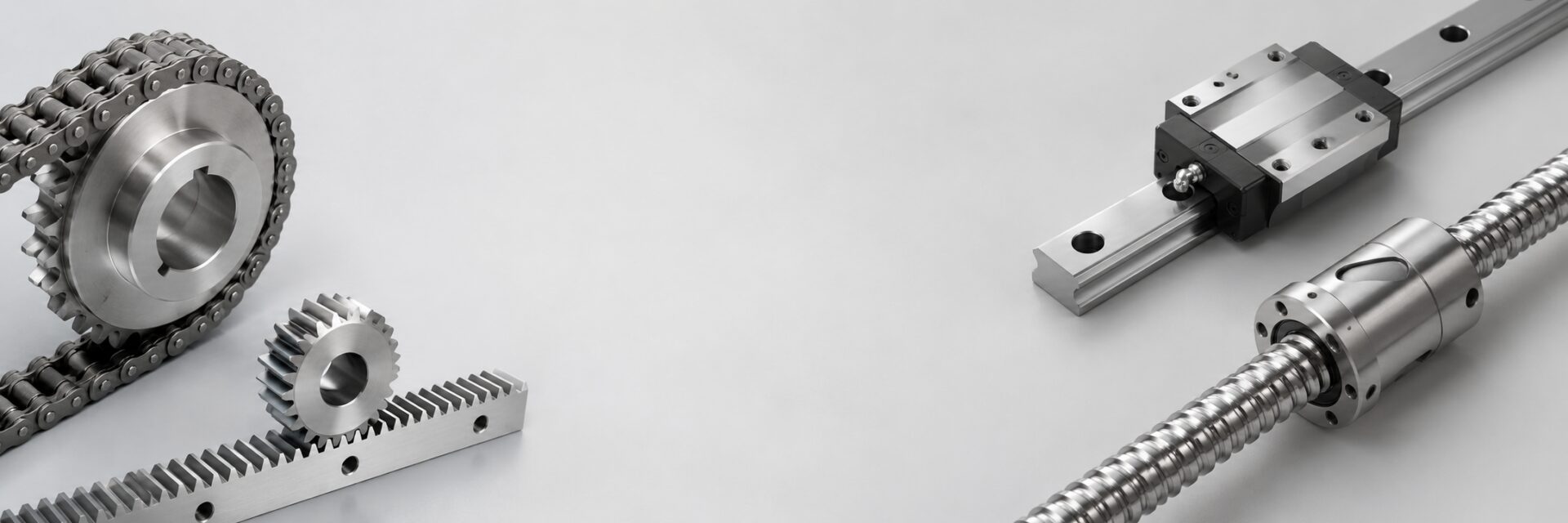
Our product range covers mechanical transmission, linear motion and drawing-based machined components.
- Gears and gear racks
- Roller chains and sprockets
- Timing belts and timing pulleys
- Linear guides and linear blocks
- Ball screws and related components
- Custom CNC machined parts
How do I select the correct product model?
Selection depends on product type, dimensions, load, speed, accuracy, installation space, operating environment and required service life.
Send the existing model, drawing, equipment information or application data so that the available options can be reviewed.
Can you supply both standard and custom products?
Yes. Standard products can be supplied according to available specifications, while custom dimensions, bores, keyways, mounting holes, materials and surface treatments can be evaluated from drawings or samples.
Can you help replace an existing product from another brand?
Cross-reference support may be possible when you provide the existing model, manufacturer, dimensions, technical parameters and application conditions.
Compatibility should be technically confirmed before ordering because products with similar names may still have different dimensions, accuracy grades or mounting details.
Are samples available before a production order?
Sample availability depends on the product, material, machining requirements and quantity. Standard items may be available in small quantities, while custom parts normally require sample production and technical confirmation.
Custom Manufacturing
What custom machining capabilities are available?
Custom production can include CNC turning, CNC milling, gear machining, drilling, grinding and related secondary operations, depending on the drawing and technical requirements.
What materials can be used for custom components?
Common options include carbon steel, alloy steel, stainless steel, aluminum, brass, bronze and selected engineering plastics.
Final material availability and alternatives should be confirmed according to mechanical properties, heat treatment and application conditions.
Can you provide heat treatment?
Heat treatment options may include through hardening, induction hardening, carburizing, nitriding, tempering and stress relief, depending on material and product geometry.
Required hardness, hardened depth and test method should be stated on the drawing or specification.
Which surface treatments are available?
Available processes may include black oxide, zinc plating, nickel plating, phosphating, anodizing, passivation and other protective finishes.
Surface finish should be selected according to material, corrosion resistance, appearance and dimensional tolerance requirements.
What machining tolerances can you achieve?
Achievable tolerance depends on component size, material, geometry, machining process and inspection method.
Critical dimensions, geometric tolerances, datum references and surface roughness should be clearly marked on the drawing for review.
Drawings & Samples
Which drawing formats can I send?
Commonly used formats include PDF, DWG, DXF, STEP, STP, IGES and other readable 2D or 3D engineering files.
A PDF drawing should preferably be included with the 3D model so that dimensions, tolerances, materials and technical notes are clearly defined.
Can you manufacture a part from a physical sample?
Sample-based production may be evaluated when an original part is available. Measurements, material identification and functional information may still be required.
A sample alone may not reveal internal material properties, heat treatment or original design tolerances.
What information should be shown on the drawing?
- Material specification
- Complete dimensions and tolerances
- Heat treatment and hardness
- Surface treatment and roughness
- Gear, spline or thread parameters
- Inspection or documentation requirements
Can you review and suggest changes to my drawing?
Manufacturing-related suggestions may be provided for materials, machining access, tolerances, heat treatment, surface finish and inspection feasibility.
Final design responsibility and approval remain with the customer.
How are revised drawings controlled?
Clearly identify the drawing number, revision number and revision date. Revised drawings should be sent before production begins.
Any change affecting material, dimensions, tolerance, treatment or quantity should be reconfirmed because it may affect cost and lead time.
Quotation & Ordering
What information is required for a quotation?
- Product name, model or drawing
- Required quantity
- Material and technical requirements
- Delivery destination
- Required delivery time
- Packaging or documentation requirements
Is there a minimum order quantity?
Minimum quantity depends on whether the item is standard or custom, as well as material, setup cost, production process and packaging.
Small trial orders may be evaluated, but the unit cost can be higher than for batch production.
How long does quotation preparation take?
Simple standard-product quotations can normally be prepared faster than custom parts. Complex drawings may require material, process and tooling review before pricing.
Complete information helps reduce the review time.
How is production lead time determined?
Lead time depends on material availability, quantity, machining complexity, heat treatment, surface treatment, inspection and packaging requirements.
The confirmed lead time should be stated in the quotation or order confirmation.
Can an order be changed after confirmation?
Changes should be requested as early as possible. Whether a change can be accepted depends on the current production stage.
Material already purchased, completed operations or tooling already produced may result in additional cost or revised delivery time.
Quality & Inspection
How are products inspected before shipment?
Inspection may include dimensions, appearance, material documentation, hardness, tooth parameters, surface finish and other confirmed technical requirements.
The inspection scope depends on the product and agreed order requirements.
Can you provide an inspection report?
Dimensional inspection reports or other quality documents may be available when requested and confirmed before ordering.
Report format, measured characteristics and sample quantity should be agreed in advance.
Are material certificates available?
Material certificates may be available for selected materials and orders. Certificate requirements should be specified before quotation because availability and cost can vary by material source.
Can you provide samples for dimensional approval?
First-piece or pre-production samples may be arranged for custom components when included in the agreed production process.
Sample approval requirements and the effect on total lead time should be confirmed before production.
What should I do if a product does not meet the confirmed requirements?
Contact us promptly and provide the order reference, product model, quantity affected, measurements, photographs and a description of the issue.
Keep the product and original packaging until the issue has been reviewed.
Packaging & Delivery
How are industrial components packaged?
Packaging is selected according to product size, weight, surface condition and shipping method.
Common methods include protective oil, individual wrapping, cartons, wooden cases, pallets and internal separation to reduce movement during transport.
Can you provide export packaging?
Export packaging can be arranged according to the product and transport method. Special requirements such as fumigation-free cases, pallet dimensions or package markings should be confirmed before shipment.
Which shipping methods are available?
Depending on shipment size, destination and urgency, delivery may be arranged by express, air freight, sea freight, rail or another agreed logistics method.
Can different products be consolidated into one shipment?
Order consolidation may be possible when products are ready within a compatible time period and packaging or customs requirements allow combined shipment.
Consolidation should be requested before shipping arrangements are finalized.
What should I do if packaging is damaged during transport?
Photograph the package before opening, record the condition with the carrier and inspect the products carefully.
Send the shipping reference, package photos, product photos and affected quantity as soon as possible for review.
Still Need Help With Your Application?
Send your product model, drawing, dimensions, quantity and application requirements. Our team will review the information and provide product selection or quotation support.


