



Blog
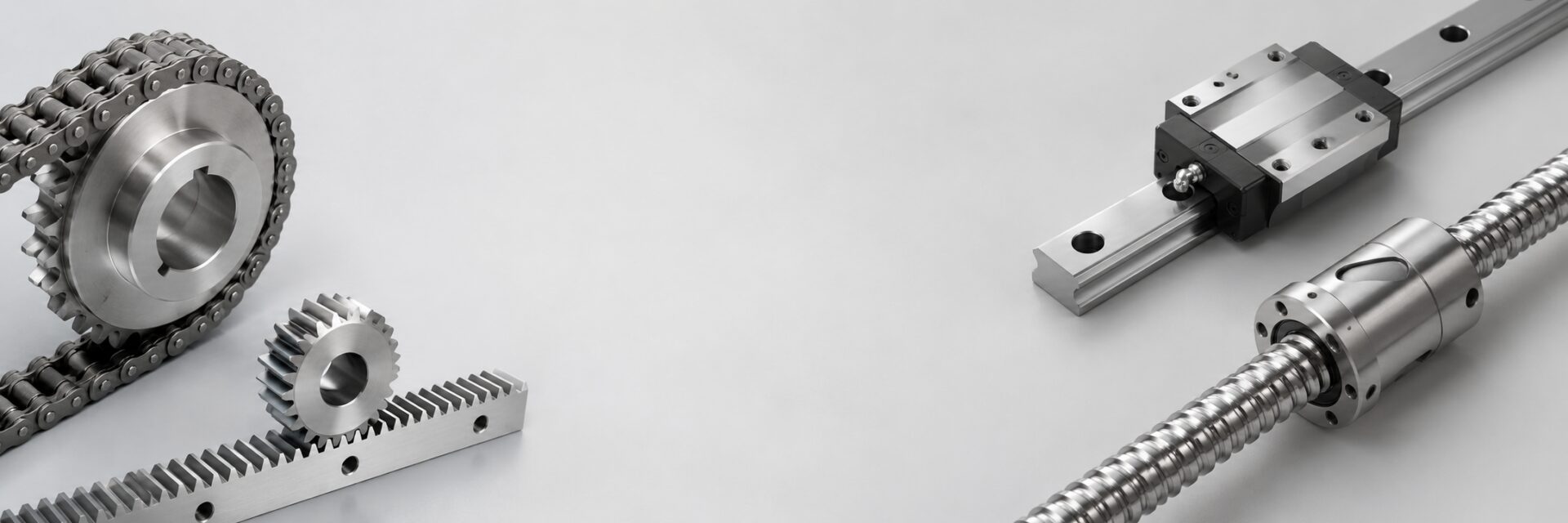
Rack and pinion drives are the usual choice when an axis is longer than a ball screw can practically support. Travel is extended by joining rack sections end to end, and several carriages can run on the same rack. This guide covers rack type, accuracy, material and the joining details that decide how smoothly a long axis runs.
Available Rack Ranges
| Rack series | Module | Tooth form | Length | Notes |
|---|---|---|---|---|
| Precision gear racks | M1 to M6 | Spur or helical, 20° pressure angle; helical reference helix angle 19°31′42″ | 1000 mm | DIN5 or DIN7; material options C45, 42CrMo, 16MnCr5, 20CrMnTi |
| Engraving machine gear racks | M1.25 to M3 | Helical, right-hand, 19°31′42″ | 1000, 1500 or 2000 mm | C45, quenched and tempered to 20–25 HRC; milled as standard, ground on request |
| Sliding gate gear racks | M4 | Spur | 1000 / 1005 mm | Nylon with steel core (2, 4 or 6 mounting eyes) or steel sections 8–12 × 30 mm |
Spur or Helical Rack?
- Spur racks are simple to install and put no axial force on the pinion. They suit general automation at moderate speed.
- Helical racks keep more teeth in contact at the same time, which gives quieter and smoother movement at higher speed. The inclined teeth create an axial force that the pinion bearings and gearbox must carry.
- A helical rack needs a pinion with the same module, pressure angle and helix angle and the correct matching hand. Spur and helical parts cannot be mixed.
Joining Rack Sections
On a long axis, the joint between sections is where pitch errors appear. Good practice:
- Mount every section against the same machined reference shoulder.
- Set each joint with a short mating rack piece (joining gauge) that meshes across both ends, then tighten the screws.
- Pin the first section after alignment and continue section by section in one direction.
- Run the pinion slowly across every joint and check for a step or tight spot.
Straight and Helical Gear Rack Options
Straight gear racks are commonly paired with spur pinions and are widely used where a simple, robust drive arrangement is required. Helical gear racks are paired with helical pinions having the matching module, pressure angle, helix angle and hand required by the design.
The gear and rack must be mechanically compatible. A helical pinion should not be presented as engaging a straight rack, and a rack and pinion should not be selected only because their outside dimensions appear similar.
Accuracy and Manufacturing Method
Milled gear racks are suitable for many general industrial applications, while ground tooth options may be considered when tighter pitch accuracy, smoother movement or improved positioning performance is required.
The required accuracy should be based on the complete axis design, including gearbox backlash, pinion quality, mounting straightness, bearing rigidity, preload method and control strategy.
Material and Heat Treatment
Material selection affects strength, machinability, heat treatment response and cost. Depending on the product series and application, common options can include medium-carbon steel and alloy or case-hardening steels.
Hardened tooth surfaces can improve wear resistance, but heat treatment should be specified together with the required core properties, finishing method and accuracy. Unhardened racks may still be appropriate for lower-load or cost-sensitive applications.
Mounting and Joining Long Rack Sections
Long axes often use multiple rack sections. Hole positions, reference surfaces and end-to-end pitch continuity are therefore important. Installation should maintain alignment and avoid steps at the joint.
Customers are encouraged to provide rack length, module, tooth direction, mounting-hole requirements, accuracy expectations and the intended pinion arrangement.
Technical Review Available
TJOND can review standard and drawing-based gear rack inquiries. Final suitability depends on the machine load, speed, duty cycle, lubrication, mounting and control requirements.
Preload and Backlash Arrangements
Rack-and-pinion axes can use a single pinion with controlled backlash or a dual-pinion arrangement designed to reduce backlash. A preload system must be engineered carefully because excessive preload increases tooth load, friction and heat. The gearbox, bearings and frame must be rigid enough to maintain the intended setting through the full travel.
When position accuracy is measured by a motor encoder, gearbox and tooth backlash remain in the control loop. A linear encoder mounted near the moving axis can improve feedback accuracy, but it does not remove the need for correct mechanical installation.
Replacement Inquiries
For an existing rack, customers should provide the complete model if available, along with module, length, tooth direction, hole spacing and photos of the end geometry. A worn rack should not be measured at only one tooth because wear may have changed the apparent dimensions.
The mating pinion should be inspected at the same time. Replacing a rack while retaining a damaged pinion can produce rapid wear on the new component.
Information Customers Can Prepare
Before requesting a gear rack quotation, prepare the module, tooth direction, pressure angle, rack length, hole pattern, quantity and required accuracy. For a new axis, also include travel, speed, moving load, process force, duty cycle and lubrication plan. Where the design uses a helical rack, identify the required helix angle and the matching pinion arrangement.
This information helps determine whether an existing standard series can be used or whether a drawing-based rack is required. Any missing value should be confirmed during technical review rather than inferred from a photograph.
Frequently Asked Questions
What is the difference between DIN5 and DIN7 gear racks?
A lower number means tighter tolerances. DIN5 racks are typically ground and used where positioning accuracy is critical; DIN7 suits many general automation axes. The grade should match the rest of the axis.
How long can a rack and pinion axis be?
The rack itself does not set a fixed limit, because sections are joined end to end. Practical limits come from the machine frame, mounting accuracy and cable management.
Can I replace only the rack?
Inspect the pinion at the same time. A worn pinion quickly wears a new rack. For sliding gates, see nylon vs steel gate racks.
Related Products
Have a drawing, a model number or only a worn sample? Send it with the operating conditions for a technical review and quotation.


