



Blog
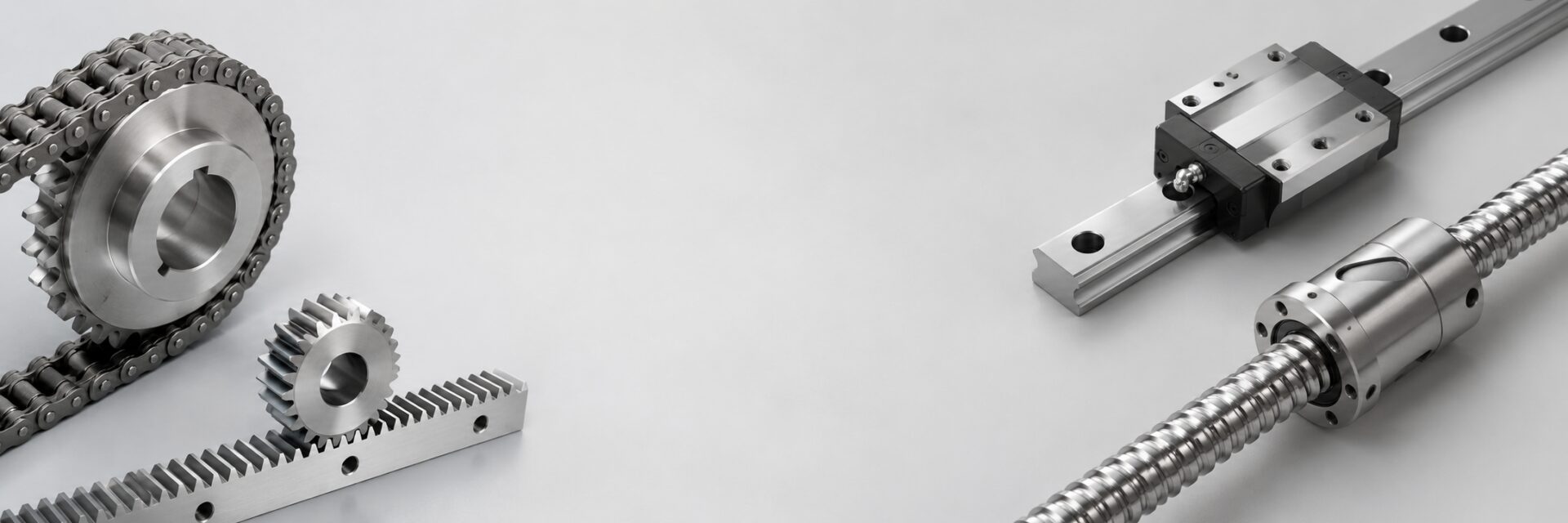
Most machine axes combine two linear motion components: a linear guide that carries the load and keeps the table straight, and a ball screw that converts motor rotation into accurate linear movement. This guide explains how to select each and how they work together.
Linear Guide Block Types
| Block type | Typical use |
|---|---|
| High / square block | Standard machine axes that need load capacity in all directions |
| Low block | Compact designs where installation height is limited |
| Flange block | Tables that are bolted from above or below |
| Miniature narrow block | Small devices, electronics and laboratory equipment |
| Miniature wide block | Compact axes that carry moment loads on a single rail |
Guides are available in HG, EG, CG, MGN, MGW, RG, WE, QH, QE and QW series, in nominal sizes from 2 to 65, with rails cut to standard or custom length. See the linear guideway range.
Ball Screw Nut Families
| Nut family | Design | Example models |
|---|---|---|
| SFU | Flange single nut | SFU1204, SFU1605 |
| DFU | Double nut, preload option | DFU1605, DFU2005, DFU5010 |
| SFE | High-lead flange nut | SFE1616, SFE2020, SFE4040 |
| SFK | Miniature compact nut | SFK0601, SFK0802, SFK1402 |
The model code gives screw diameter and lead: SFU1605 has a 16 mm screw and a 5 mm lead. Screw diameters range from 6 to 80 mm and leads from 1 to 40 mm. Ball screws are specified according to ISO 3408. See the ball screw range.
Rolled or Ground Ball Screws
Rolled ball screws are formed by thread rolling and are cost-effective for general automation, pick-and-place and transfer axes. Ground ball screws are finished by grinding and are used where lead accuracy and smooth running are critical, for example on machine tool axes. Both are available with preload options by requirement.
Choosing the Lead
A larger lead gives more linear speed per motor revolution but less thrust and resolution for the same motor torque. A smaller lead gives finer positioning and higher thrust at lower speed. High-lead nuts such as SFE suit fast transfer axes; small leads suit precise positioning.
Linear Guides for Stable Guided Motion
Linear guide systems support and guide moving assemblies while controlling motion along a defined axis. Product selection depends on load direction, moment load, mounting arrangement, rail spacing, preload, accuracy and environmental protection.
A rail and block should be treated as part of the machine structure rather than as an isolated component. Base flatness, mounting shoulder accuracy, bolt tightening sequence and lubrication can all affect service life and motion quality.
Ball Screws for Efficient Motion Conversion
Ball screws convert rotary input into linear movement with high mechanical efficiency. Selection normally considers axial load, speed, critical speed, buckling, required lead, travel, support arrangement and accuracy.
The end machining and support units must match the machine design. Customers should provide a drawing or clear end-detail dimensions when a ball screw requires custom shaft-end machining.
Combining Guides and Ball Screws
A ball screw should transmit axial force but should not be expected to guide the table by itself. Linear guides or another suitable guiding system are normally required to control lateral loads and moments.
The alignment between the ball screw axis and the guide system is important. Misalignment can increase friction, heat, noise and premature wear.
Information Needed for Review
Useful inquiry information includes moving mass, external force, speed, acceleration, travel, duty cycle, mounting orientation, desired accuracy, environmental conditions and available installation dimensions.
Existing model numbers can be used for replacement inquiries, but customers should confirm whether the replacement must be fully interchangeable or whether modifications are acceptable.
Supporting Standard and Custom Requirements
TJOND supplies standard linear motion components and can review drawing-based requirements involving rail length, hole patterns, ball screw length, end machining and associated custom parts.
Rail and Block Interchangeability
Linear guide products with similar nominal sizes are not always interchangeable. Block height, rail width, mounting-hole pitch, seal arrangement, preload and accuracy can differ between series. A replacement inquiry should therefore include the full model number and, where possible, a drawing of the installed dimensions.
Customers should also confirm whether they require one block, one rail, a complete axis set or a matched set. Mixing components from different series or accuracy classes may affect fit and running performance.
Protecting Linear Motion Components
Machine builders should plan covers, lubrication access and drainage at the design stage. Chips, abrasive dust and coolant can shorten the life of both linear guides and ball screws. Protection is particularly important on woodworking, metal-cutting and outdoor equipment.
Regular inspection of seals, wipers, lubrication lines and support bearings can prevent small problems from becoming expensive axis failures.
Information Customers Can Prepare
Customers preparing a linear motion inquiry should list the rail and block model or required size, number of blocks, rail length, load, moment, speed, preload, accuracy and environmental protection. Ball screw inquiries should include diameter, lead, total length, travel, nut type and end-machining details.
Providing the axis layout helps identify whether the support arrangement, guide spacing and ball screw position are consistent with the required performance.
Frequently Asked Questions
Can a ball screw guide the table without linear guides?
No. A ball screw should carry axial force only. Linear guides or another guiding system must take lateral loads and moments.
What does the model DFU2005 mean?
DFU is the double-nut family, 20 is the screw diameter in millimeters and 05 is the lead in millimeters.
Do I need a preloaded ball screw or guide?
Preload removes play and increases stiffness but adds friction and heat. It is useful on reversing axes that need accuracy; many transfer axes run well without it.
Related Products
Have a drawing, a model number or only a worn sample? Send it with the operating conditions for a technical review and quotation.


