



Blog
Nylon vs Steel Gear Racks for Sliding Gates

Nylon and steel sliding gate racks are usually offered side by side at very different prices, which makes the choice look like a budget decision. It is not. The two materials fail in different ways, and the right one depends on gate weight, duty cycle and site conditions.
Both types in our range share the same M4 module, so either will mesh with an M4 pinion on a standard gate operator. Pitch compatibility is not the deciding factor. Everything that matters happens after installation.
What Each Type Physically Is
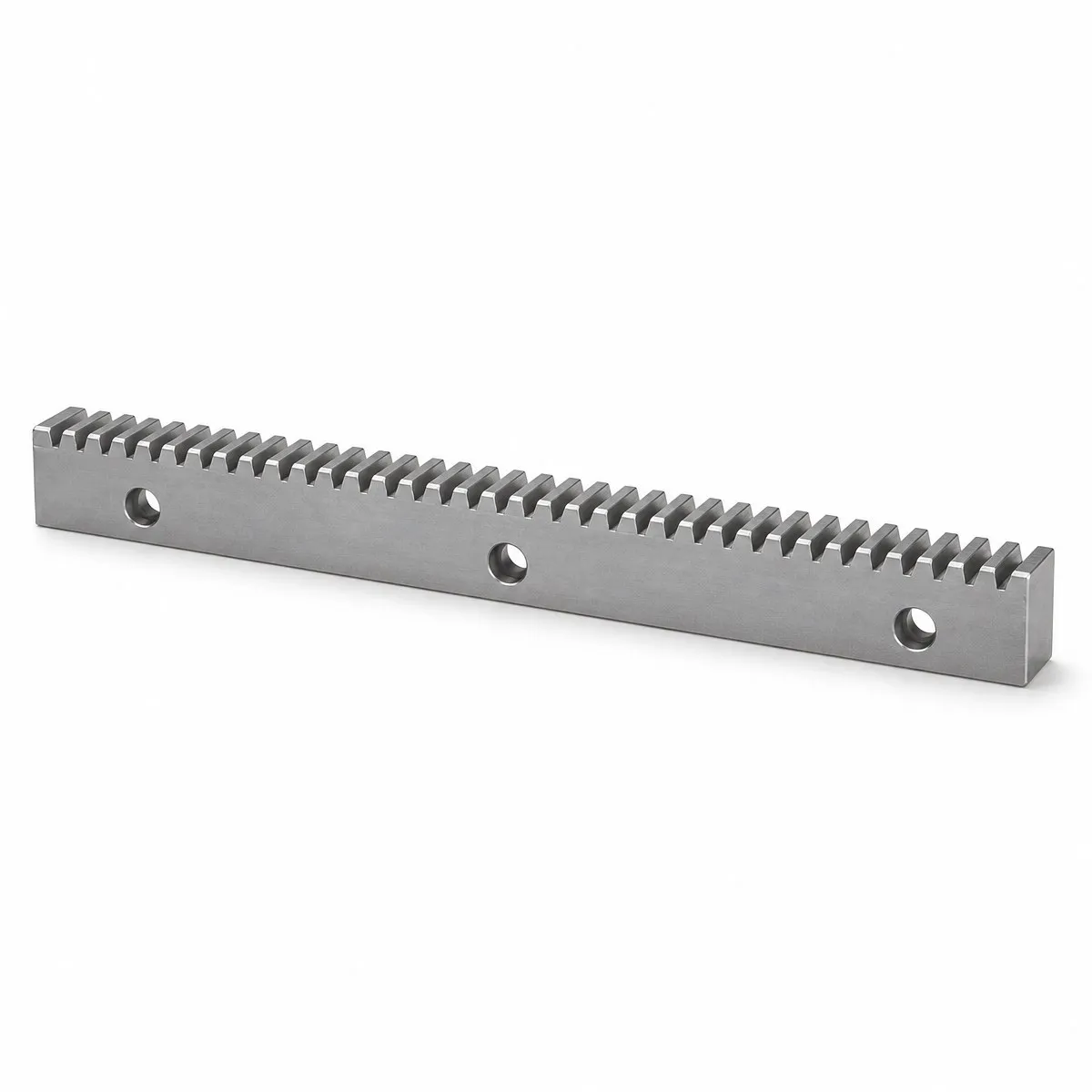
A steel gate rack is a toothed steel section with mounting holes along its length, fixed by bolting or welding to the gate frame. Our steel range covers M4 in section thicknesses from 6 to 30 mm and an M6 option, supplied in 1 m and 2 m lengths, with section weights from 1.75 to 5.5 kg per metre.
A nylon gate rack is a reinforced polymer body moulded around a steel core, with pressed mounting eyes that accept screws and allow height adjustment during fitting. Our nylon range is M4 with two, four or six mounting eyes depending on span and load.
The steel core in a nylon rack is the detail buyers most often miss. It carries tensile load along the rack so that the polymer handles tooth contact rather than structural duty. A nylon rack without that core behaves very differently, and the two should not be compared as if they were the same product.
Noise
Nylon is quieter, and the difference is not marginal. Polymer teeth damp the impact as each tooth enters mesh, and they do not ring the way a steel section fixed to a steel gate frame does. On a residential gate opening several times an hour a few metres from a bedroom window, this is often the deciding factor on its own.
Steel racks can be made acceptably quiet with correct mesh depth, alignment and lubrication, but they will not match nylon. A steel rack that has become noisy is usually telling you something — mesh too deep, rack not parallel to the travel, or lubrication gone.
Corrosion
Nylon does not corrode, which is its strongest argument in coastal, humid or chemically aggressive environments. The steel core is enclosed, and the exposed surface is unaffected by salt spray.
A steel rack in the same environment depends entirely on its surface protection, and that protection is thinnest exactly where it matters — on the tooth flanks, where contact wears the coating away first. Once flank coating is gone, corrosion starts in the working surface rather than on a cosmetic face. On an uncoated or damaged steel rack in a marine setting, this is the normal failure path.
Load and Gate Weight
Steel carries more tooth load, tolerates shock better and does not deform under sustained pressure. For heavy industrial gates, high-frequency commercial cycling or anywhere a vehicle might contact the rack, steel is the appropriate specification and nylon is not a substitute.
Polymers also creep — they deform slowly under continuous load in a way steel does not at ambient temperature. On a heavy gate that rests its weight against the mesh when stationary, this shows up over time as changed backlash and a loosening tooth contact. On a light gate that does not load the rack at rest, creep is not a practical concern.
We do not publish a gate-weight limit for the nylon range, because the real limit depends on operator torque, mounting rigidity, cycle frequency and how the gate is supported. If your gate is near the boundary, send the weight, the operator model and the cycle count and we will give a specific answer rather than a category rule.
Thermal Movement
Nylon expands and contracts considerably more than steel over the same temperature swing. On a long gate in a climate with a wide annual range, that movement is real and has to be allowed for — which is one reason nylon racks are supplied with adjustable mounting eyes rather than fixed holes.
Installations that ignore this show a seasonal pattern: mesh that was correct in summer becomes tight in winter, or a gate that ran quietly in mild weather starts binding in a cold snap. The fix is at installation, in how the mounting allows movement, not in the rack.
Steel moves too, but it moves at close to the same rate as the steel gate frame it is bolted to, so the relative movement between rack and structure is small.
Mounting and Adjustment
Nylon racks with mounting eyes are quicker to install and easier to correct. The eyes give vertical adjustment, so mesh depth can be set on site without re-drilling, and a section can be shimmed if the gate frame is not perfectly straight.
Steel racks are less forgiving. They need the mounting line to be straight and the mesh depth correct before fixing, particularly if welded. The payoff is that once fixed correctly they stay where they are put.
The eye count on a nylon rack is a load-spreading decision, not a convenience one. More eyes means shorter unsupported spans between fixings and less flex under tooth load. On a heavier gate or a less rigid frame, a six-eye rack behaves noticeably better than a two-eye rack of the same length.
How Each Type Wears
This is the practical difference that matters most over a decade of service.
A nylon rack wears gradually and predictably. Teeth thin, backlash grows, the gate gets slightly less precise about where it stops. It gives warning, and it rarely takes the pinion with it — the polymer sacrifices itself in preference to the steel gear.
A steel rack barely wears at all if lubricated, and then wears fast once the lubricant is gone. Steel-on-steel contact without lubrication damages both parts, so a neglected steel rack can also cost you the operator pinion. Failure is less gradual and more expensive when it comes.
That reverses the usual expectation about which is the low-maintenance option. Nylon is lower maintenance; steel is longer-lived if maintained. Our article on common causes of gear rack wear covers the lubrication side in more detail.
Cost Over the Life of the Gate
Nylon is cheaper to buy and cheaper to install. Steel costs more initially and usually outlasts it by a wide margin in a protected, lubricated, correctly loaded installation.
The comparison changes with environment. In a coastal setting an unprotected steel rack may not reach its theoretical life, and the nylon rack becomes the better economic choice as well as the easier one. Inland, on a heavy gate, with maintenance actually performed, steel wins on cost per year.
Choosing
Choose nylon when: the gate is light to medium weight, noise matters, the site is coastal or humid, installation speed matters, or the gate will not receive regular lubrication.
Choose steel when: the gate is heavy, cycling is frequent or commercial, impact is possible, the environment is dry or the rack is protected, or you need the longest service life and will maintain it.
Frequently Asked Questions
Can I replace a nylon rack with steel without changing the pinion?
If both are the same module — M4 in our standard ranges — the pinion meshes with either. Check mounting: a steel rack needs a straight, rigid fixing line and does not offer the height adjustment the nylon eyes provide.
Can nylon and steel sections be mixed on one gate?
Mechanically possible at the same module, but not advisable. The two expand at different rates and wear at different rates, so the joint between them becomes the weak point and mesh depth drifts unevenly along the gate.
Does a nylon rack need lubrication?
It does not require it, and that is part of the appeal. Avoid greases that are not compatible with the polymer, and keep grit out of the mesh — abrasive particles embedded in a polymer tooth will wear the steel pinion.
Why is my nylon rack wearing faster on one section?
Almost always mounting rather than material. A section set with mesh too deep, or a span between fixings that flexes under load, concentrates contact on a few teeth. Check mesh depth along the full travel and add fixings where the rack deflects.
Final Review Checklist
- Confirm gate weight, operator torque and daily cycle count before choosing material.
- Match module between rack and existing pinion.
- Assess the environment honestly — coastal and humid sites change the answer.
- Choose eye count on nylon racks by load and frame rigidity, not by length alone.
- Allow for thermal movement on long nylon installations.
- Decide whether lubrication will realistically be performed; if not, prefer nylon.
- Set and verify mesh depth across the full travel after fitting.
We manufacture both types as a transmission component factory, and supply to drawing where a gate needs a non-standard length, section or hole pattern. If you are unsure which suits your installation, send the gate weight, environment and operator details and we will recommend on the engineering rather than on the price.


That was amazing