



Blog
Curved vs Straight Gear Racks for Greenhouse Vents

Buyers sourcing replacement vent components regularly ask which rack form they should be using, and the honest answer is that it is not usually a choice. The mechanism already determines it. What people actually need is a way to tell which one their mechanism requires — and to recognise the cases where the existing arrangement was wrong from the start.
This comparison works through how to read that from the vent itself.
The Determining Question: What Path Does the Rack Travel?
Everything follows from one observation. Watch the vent open and ask where the rack is fixed.
If the rack is fixed to a push rod or a sliding carriage, and the pinion drives it along a fixed guide, the rack travels in a straight line. The sash swings, but the rack does not — the linkage absorbs the angular change. This needs a linear rack.
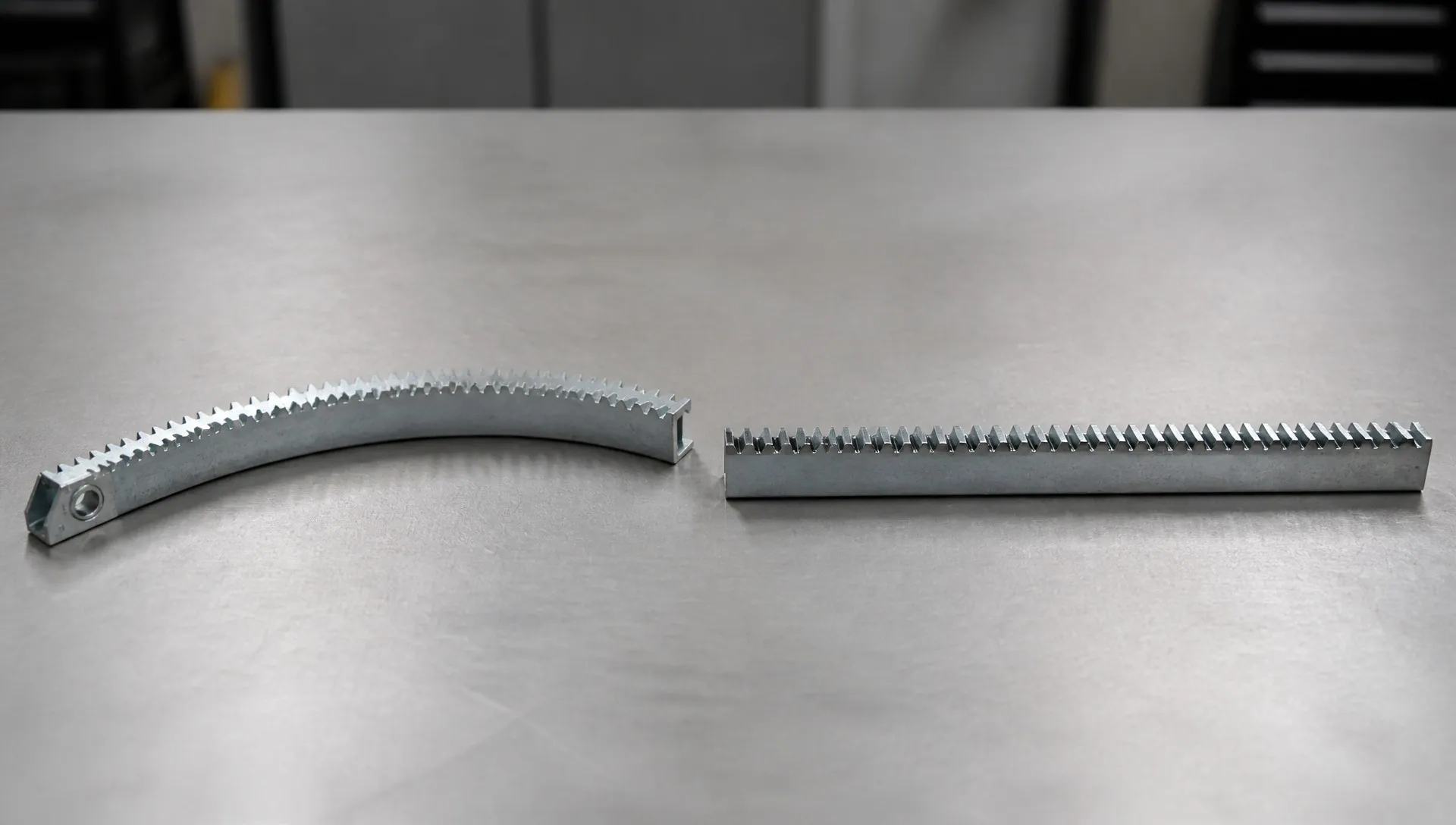
If the rack is fixed directly to the sash and swings with it about the sash hinge, the rack travels along an arc. The centre of that arc is the hinge. This needs a curved rack whose radius matches the hinge distance.
There is no middle case, and no adjustment that converts one into the other. A linear rack bolted to a swinging sash binds within a few degrees; a curved rack in a straight guide only touches the pinion at one point.
Direct Comparison
| Factor | Straight (linear) rack | Curved (arc) rack |
|---|---|---|
| Rack travel path | Linear, along a fixed guide | Arc, centred on the sash hinge |
| Mounted to | Push rod or sliding carriage | The sash itself |
| Linkage required | Push rod plus support arm | Few or no intermediate links |
| Defining dimension | Length | Radius, then chord length |
| Interchangeability | Any length can be cut from stock section | Radius is specific to the mechanism |
| Mounting depth needed | Clear straight run for full stroke | Swept arc clearance, usually shallower |
| Parts count | Higher — linkage components | Lower — fewer pivots to wear |
| Typical unit cost | Lower per rack | Higher per rack, offset by fewer linkage parts |
| Lead time on replacement | Short — commonly stocked | Longer — made to geometry |
Where Straight Racks Are the Right Answer
Linear racks dominate continuous ridge ventilation, and for sound reasons.
A ridge bay may run sixty metres with twenty vent positions on one shaft. Linear racks let every position use identical parts, cut from the same section, with the same pinion. Stock one length and one pinion and the entire bay is covered — including spares.
The linkage also does useful work. A push rod and support arm can be dimensioned to give mechanical advantage at the start of the stroke, which is where the sash is heaviest to break free. A directly-mounted curved rack does not offer that adjustment; the mechanical advantage is whatever the geometry gives.
Lead time is the other practical factor. A linear rack is a length of toothed section — replaceable quickly. Where a facility needs to restore ventilation before the next hot day, that matters more than elegance.
Where Curved Racks Become Necessary
Arc-form racks appear where the mechanism has no room for a linkage, or where the sash motion is short and steep.
Confined mounting depth. A linear rack needs a clear straight run at least as long as its stroke. In vent designs where the glazing bar sits close behind the sash, that run does not exist. An arc segment sweeps through a shallower envelope.
Direct-drive sash designs. Some vent frames are built to be driven directly at the sash edge, with no push rod at all. Fewer pivots means fewer wear points and less accumulated lost motion — attractive in a humid environment where every pivot is a corrosion site.
Large opening angles. Where the sash swings through a wide arc, the linkage geometry of a linear system becomes awkward — the angle between push rod and support arm moves far from optimum at the ends of the stroke, and force transmission drops off. A curved rack keeps tooth engagement constant across the whole swing.
Retrofit onto an existing curved mounting. If the sash already carries a curved mounting rail, the decision was made when the house was built.
What the Comparison Costs You in Practice
The per-part price comparison is misleading on its own. A curved segment costs more than an equivalent length of linear rack, but the linear system also needs a push rod, a support arm and two or three pivot points, each of which is a part to buy, install, and eventually replace.
Over a fifteen-year service life the more useful comparison is total wear points. A linear arrangement has the rack-pinion mesh plus every pivot in the linkage. A direct-drive curved arrangement has the mesh and the sash hinge. In a facility running near saturation humidity, each additional pivot is somewhere corrosion can seize the mechanism.
Against that, the linear system’s advantage is that every one of those parts is simple and quickly available, while a curved segment with the wrong radius is worth nothing at all.
Reading Your Own Mechanism
If you are unsure which you have, work through these:
- Open the vent halfway and look at the rack. Has it moved along a straight guide, or swung with the sash?
- Look for a push rod. A rod between the rack and the sash means linear. Rack bolted straight to the sash frame means curved.
- Lay the removed rack on a flat surface. If it rocks or shows daylight under the middle, it is an arc — check whether that is by design or deformation.
- Measure chord and rise. Straight line between the end holes is the chord; perpendicular height from that line to the arc is the rise. A rise of more than a millimetre or two over the segment length indicates a genuine curve.
Point three is worth care. A linear rack that has been bent in service also fails to sit flat, and it can be mistaken for a curved part. The distinguishing feature is tooth pitch: on a manufactured arc the pitch is consistent along the curve, whereas a bent linear rack shows pitch opened on the outside of the bend and closed on the inside. Measuring across ten teeth at each end will show it.
Can You Convert From One to the Other?
Occasionally, and it is usually not worth it.
Converting a curved arrangement to linear means adding a push rod and support arm, and finding mounting points for both on a sash frame that was not designed for them. Converting linear to curved means removing the linkage and mounting a radius-matched segment directly to a sash whose hinge position you now need to measure precisely.
The case where conversion does make sense is a mechanism that was wrongly specified originally — most often a linear rack fitted to a directly-driven sash, which binds partway through the stroke from the day it is installed. If a vent has never opened smoothly since commissioning, geometry is the first thing to check.
Sourcing Implications
If you have concluded you need linear racks, sourcing is straightforward: confirm tooth pitch, section and length, then order.
If you need curved racks, the sourcing problem is different in kind. The radius is specific to your mechanism, and a supplier cannot ship one from stock. What they need from you is chord length, rise, tooth pitch and hole positions — see our curved gear rack production page for exactly which measurements to take from a worn part.
Where both the rack and its pinion need replacing, ordering them together avoids the tooth-form mismatch that comes from splitting the order — our matched rack and pinion set covers that case.
FAQ
Q: Is a curved rack stronger than a straight one?
Not inherently. Load capacity comes from module, section and material, which apply to both. What differs is the load path: a direct-drive curved arrangement transmits force to the sash without the intermediate linkage, so there are fewer places for lost motion to accumulate.
Q: Can I fit a curved rack where a straight one is now?
Only if the rack mounts directly to the sash. If a push rod is present, the rack is not following the sash arc and a curved segment has nothing to follow.
Q: Why are curved racks harder to source?
Because radius is not interchangeable. A linear rack of any length works if the pitch matches; a curved segment with the wrong radius does not fit any mechanism at all.
Q: Do both use the same pinion?
The pinion requirement is identical in tooth terms — same module, same pressure angle, same profile. Only the rack geometry differs.
Q: My vent binds halfway through its stroke. Does that mean I have the wrong rack type?
It might, particularly if it has behaved that way since installation. If it developed gradually, alignment or sag is the more likely cause — see our vent drive troubleshooting guide.
Q: Can a curved rack be cut down to a shorter segment?
Yes, provided the radius is right and the cut ends get new fixing holes. What cannot be adjusted is the radius itself.
Conclusion
The choice between curved and straight racks is made by the vent mechanism, not by preference. Rack fixed to a push rod means linear; rack fixed to a swinging sash means arc. Reading which one you have takes one look at a half-open vent.
Where the decision is genuinely open — a new mechanism being designed — linear racks favour long ridge runs with many identical positions, quick spares and adjustable mechanical advantage. Curved racks favour confined mounting depth, wide opening angles and designs that eliminate linkage pivots.
The costly mistake is not choosing wrongly between two valid options. It is ordering a replacement for the arrangement you assume you have, rather than the one on the roof.
Not sure which rack form your vents use?
Send photographs of the mechanism half-open, showing where the rack attaches, plus the chord length and rise if the rack appears curved. We will identify the arrangement and confirm what replacement geometry is required.
Designing a new vent mechanism? Send the sash hinge position, opening angle and available mounting depth, and we will work through which rack form suits the geometry before tooling is committed.


